📖 Daily Scripture
Friday, June 19, 2026 — Friday of the Eleventh Week in Ordinary Time
Readings: 2 Kings 11:1-4, 9-18, 20 • Psalm 132:11, 12, 13-14, 17-18 • Matthew 6:19-23
There is a hidden continuity between the two scenes the Church sets before the soul this day, though at first they seem to share nothing. In the one, a queen grasps at a throne by blood, and her power, which seemed so absolute, endures but seven years before it is torn from her in a single morning; in the other, the Lord speaks quietly of moth and decay and of the thief who breaks in by night, and bids the soul lay up for itself a treasure that no ruin can reach. Both are concerned with the same question, the question that lies beneath every life however it is spent: where shall a person place that which he most loves, and what shall he trust to keep it safe?
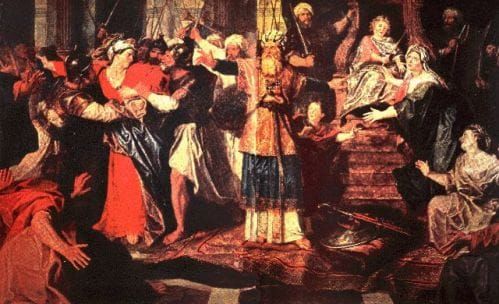
For Athaliah had her treasure, and it was a treasure of dominion and of fear; she had bound her whole heart to it, and when the trumpets sounded for another she could only cry treason and be led out to her death. Yet through all those years, while she reigned and thought herself secure, the true heir lay hidden in the temple of the Lord, and the lamp of David was not extinguished. The psalmist understood this well, who heard the Lord declare that He had chosen Zion for His resting place, and that there He would make a lamp to shine for His anointed. The treasure that endures is always the one kept in God's own house, guarded not by our anxious watching but by His fidelity.
This is the lesson the soul is asked to take to itself: that the heart is never neutral, never without a master, but follows wherever its treasure has gone before it. For where your treasure is, there also will your heart be. The danger against which the Lord warns is named with precision in the Church's teaching, that idolatry consists in divinizing what is not God, and that a man commits it whenever he honors and reveres a creature in place of the Creator, be it power or pleasure or money. The peril is not that gold is evil, but that the heart, fastening itself to what cannot last, is dragged downward and enslaved. Chrysostom saw this with unsparing clarity: even should a man escape the moth and the decay and the thief, the enslaving of his heart, the nailing of it to all that is below, he will not escape.
And here the Lord turns from the treasure to the eye, for the two are one teaching. The lamp of the body is the eye, He says, and if the eye is sound, the whole body will be filled with light. So it is with the inward eye, the intention by which the soul looks out upon the world and chooses what it shall love. If that gaze is single, bent wholly upon God, the whole interior man is luminous; but if it is divided, half upon heaven and half upon the things that perish, then the very light within becomes darkness, and how great is that darkness. For the heart is our hidden center, the place of truth where we choose life or death; and what we treasure there will either kindle it or quench it.
What is asked of the soul, then, is not contempt for the good things of this life, but a right ordering of its love, that desire for true happiness which frees a man from his immoderate attachment to the goods of this world so that he can find his fulfillment in the vision and beatitude of God. To give alms, to loosen the grip of possessions, to fix the affections upon what is eternal, is not to lose but to transfer one's treasure to the only place where it can be kept whole, where it bears fruits that never die. Augustine, who had scattered his heart among many things before he found the one thing necessary, confessed at last the secret hidden in every restlessness: that God has made us for Himself, and our heart is restless until it rests in Him. The soul that lays up its treasure in heaven is simply the soul that has consented, at last, to dwell where it was always meant to rest, and there to find its lamp forever lit.
Lord, teach me to know where my treasure truly lies, and to loosen my grasp upon all that cannot last. Cleanse the eye of my heart that it may look upon You with a single gaze, and let the lamp You kindle within me never fall into darkness. Draw my restless heart home to its rest in You alone. Through Christ our Lord. Amen.
Sources & References
- Athaliah and the hidden heir Joash; the fall of the usurping queen — 2 Kings 11:1-4, 9-18, 20 (First Reading)
- The Lord has chosen Zion for his dwelling; I will place a lamp for my anointed — Psalm 132:13-14, 17 (Responsorial Psalm)
- Where your treasure is, there also will your heart be — Matthew 6:21 (Gospel, Matthew 6:19-23)
- The lamp of the body is the eye; if your eye is sound, your whole body will be filled with light; how great will the darkness be — Matthew 6:22-23 (Gospel)
- Idolatry consists in divinizing what is not God; a man commits it whenever he honors and reveres a creature in place of God — power, pleasure, money — Catechism of the Catholic Church, no. 2113
- The heart is our hidden center; it is the place of truth, where we choose life or death — Catechism of the Catholic Church, no. 2563
- Desire for true happiness frees man from his immoderate attachment to the goods of this world so that he can find his fulfillment in the vision and beatitude of God — Catechism of the Catholic Church, no. 2548
- The enslaving of your heart, the nailing it to all that is below, you will not escape; the heavenly treasure that bears fruits which never die — St. John Chrysostom, Homily 20 on the Gospel of Matthew
- You have made us for Yourself, and our heart is restless until it rests in You — St. Augustine, Confessions, Book I
- Papal insight — Pope Francis, morning meditation “Treasure hunt,” Domus Sanctae Marthae, 20 June 2014, preached on these very readings: earthly treasure chains the heart, while a free heart is a luminous heart. (The Vatican News Word of the Day for June 19, 2026 was not yet available, so this papal teaching on the same readings was used in its place.)