The Mercy Hidden in the Fire
Readings: Sirach 48:1-14 • Psalm 97 • Matthew 6:7-15
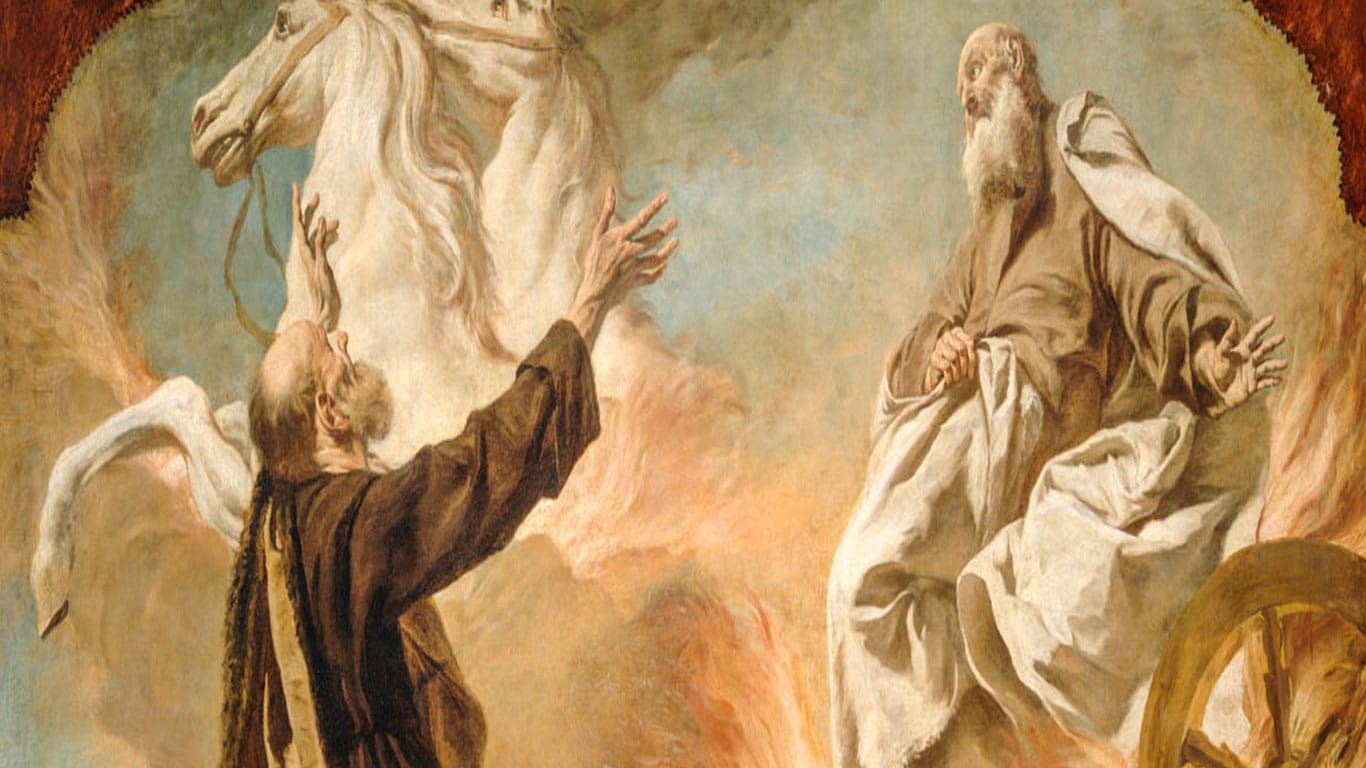
The readings of this day begin in fire. Elijah comes before us "like a fire," his word "a flaming furnace"; he seals the heavens, calls down flame upon the mountain, and summons the dead to life again. The Psalmist takes up the same vision and carries it higher still, setting the Lord upon a throne of cloud and lightning, before whom "the mountains melt like wax" and the earth itself sees and trembles. Were the soul to rest only here, it might well draw back in reverent fear, persuaded that a God so wrapped in majesty must dwell forever beyond its reach, in a glory no creature may approach and live.
And yet it is the singular wonder of the Gospel that the fire should come near, and not consume. The same Lord whose holiness unsettles the mountains inclines toward His creatures and says, "Your Father knows what you need before you ask him." Then, with a tenderness that exceeds all expectation, He sets upon the lips of His own the prayer the Church has carried through every age: Our Father. Here is the paradox in which the whole of faith is contained. The God of the whirlwind and the flame is the very God who desires to be addressed as Father; and reverence and intimacy, which the natural mind holds apart, are discovered at last to be one. The Majesty that fills the heavens stoops to claim us as His children, and in that stooping loses nothing of its grandeur.
The Fathers understood the greatness of the gift. Tertullian named the Lord's Prayer "the summary of the whole Gospel," for in a few words our Savior has gathered all things: the hallowing of the divine name, the coming of the Kingdom, the bread of each day, and the mercy that must be at once received and given. Augustine, writing to the widow Proba, went so far as to say that "if we pray rightly and fittingly, we can say nothing but what is already contained in the Lord's Prayer." When language fails, when the heart is too burdened to frame its own petition, this is the prayer to which one may always return; for in it Christ teaches not merely how to pray, but what it is that a soul ought to desire.
But there is a word joined to this prayer that we are not permitted to pass over lightly, the single petition the Lord pauses to explain: "If you forgive others their transgressions, your heavenly Father will forgive you. But if you do not forgive others, neither will your Father forgive your transgressions." The Catechism calls the saying "astonishing," and teaches that the mercy of God "cannot penetrate our hearts as long as we have not forgiven those who have trespassed against us." It is a sentence to be received with trembling. We approach the throne to beg a pardon we are ourselves slow to grant; we ask to be forgiven beyond all measure, while measuring out our own forgiveness with a careful and reluctant hand.
Herein lies the lesson the day quietly presses upon the conscience. The worth of prayer is disclosed not in the eloquence of its words but in the breadth of its mercy. "The Lord's Prayer," the Catechism observes, "reveals us to ourselves at the same time that it reveals the Father to us." To say Our Father in sincerity is to confess that the one who has wounded me is a child of the selfsame Father — a brother, a sister, beloved of the God whom I presume to call my own. I cannot stretch the one hand toward heaven while I close the other against my neighbor.
Let the soul, then, look inward before it lifts its voice. Is there one whom it will not forgive? The fire of Elijah, the trembling of the mountains, the Kingdom for whose coming we daily plead — all of it must pass through this narrow and holy gate. Our Lord does not require that the wound be unfelt; He asks only that the debt be laid down, that His own patience and mercy be suffered to remake us, until, as the Catechism so beautifully says, "his face may be reflected in ours as in a mirror."
For the God who knows our need before we speak does not wait to be impressed; He waits to be imitated. Let the soul begin where He bids it begin, with mercy, and the whole of this prayer will unfold into life within it. The fire that once fell upon the prophets burns now, gently and without consuming, in every heart that forgives; and that fire is nothing other than the love of God Himself.
Father most holy, who know our every need before we speak, yet in Your tenderness bid us call You Father: teach me to pray as Your child, and pour Your mercy so deeply within me that I forgive as I have been forgiven, until Your face is reflected in mine. Through Christ our Lord. Amen.
——————————
Sources & References
• Sacred Scripture: Sirach 48:1-14; Psalm 97; Matthew 6:7-15
• "the summary of the whole Gospel" — Tertullian, On Prayer (De Oratione), ch. 1
• "if we pray rightly and fittingly…" — St. Augustine, Letter 130 (to Proba)
• "astonishing"; "cannot penetrate our hearts…" — Catechism of the Catholic Church, 2838
• "the Lord's Prayer reveals us to ourselves…" — Catechism of the Catholic Church, 2783
• "his face may be reflected in ours as in a mirror" — Pope Leo XVI, Angelus, 27 July 2025